
Agentic commerce: preparing for the next evolution of digital retail

Unsplash
Agentic commerce is reshaping how people discover, evaluate, and purchase products online. Instead of shoppers manually browsing websites, comparing options, and completing checkout forms, AI agents can now act on their behalf by researching products, making decisions, and even completing transactions, marking a massive shift in digital retail.
Just as mobile commerce transformed shopping in the 2010s, agentic commerce is redefining it in the age of generative AI. It introduces a new model in which intelligent agents powered by large language models and connected systems move from assistants to autonomous actors in the buying journey.
This raises some questions for e-commerce businesses of all sizes:
- What is agentic commerce?
- How does agentic commerce work?
- Who are the key players in agentic commerce?
- How can you increase sales in AI-driven environments?
- Is agentic commerce secure?
- Future perspectives: what’s next?
What is agentic commerce?
Agentic commerce is a model of e-commerce in which AI agents autonomously perform shopping tasks on behalf of consumers, including product discovery, price comparison, selection, and payment processing. It’s also sometimes referred to as a-commerce, autonomous shopping, AI-driven commerce, and agent-initiated payments.
The defining characteristic is delegated decision-making. The consumer sets preferences, budgets, constraints, and rules, while the AI agent executes within those boundaries.
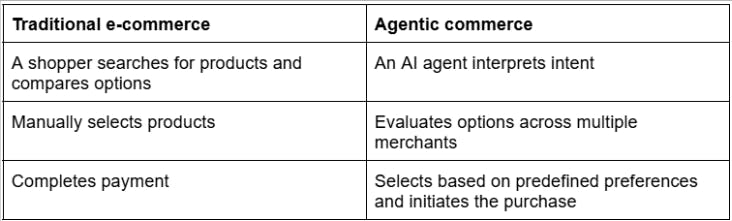
For example, instead of searching for “best noise-canceling headphones under $300,” comparing five tabs, and entering card details, a shopper might simply instruct AI to:
“Find the best-rated noise-canceling headphones under $300 and order them.”
The AI agent evaluates inventory, pricing, reviews, shipping times, and return policies. Then it completes the transaction using stored credentials and approved payment methods, transforming commerce from interface-driven to intent-driven.
How does agentic commerce work?
The workflow
Agentic commerce workflows remove friction from the checkout funnel, but under the surface, it’s complex. Here’s a simplified agentic commerce workflow:
- Intent capture. The user expresses a goal: “Book a weekend hotel in Madrid under $500.”
- Preference alignment. The AI accesses stored preferences (brand loyalty, delivery speed, sustainability filters, payment method).
- Data aggregation. The agent pulls structured data from merchant APIs, marketplaces, and platforms.
- Decision modeling. It ranks options using pricing, reviews, availability, and user constraints.
- Authorization and consent. The user confirms (or pre-authorizes within set parameters).
- Agent-initiated payment. The AI executes the transaction through a secure payment infrastructure.
- Post-purchase management. Confirmation, tracking, and even returns can be managed by the agent.
The technological infrastructure
Agentic commerce is only possible because of several underlying technologies:
- Large language models (LLMs). These interpret intent and convert natural language into structured actions.
- APIs and structured merchant data. AI agents rely on standardized data access. Product feeds, pricing APIs, inventory updates, and payment endpoints must be machine-readable.
- Identity and authentication systems. Agents require secure delegated authentication to act on behalf of shoppers.
- Tokenized payments. Sensitive payment data cannot be exposed. Instead, tokens represent payment credentials.
- Real-time processing. Agent decisions often happen instantly. Payment infrastructure must support immediate authorization and confirmation.
- Orchestration layers. When agents operate across borders and processors, routing transactions intelligently becomes critical.
Agentic commerce depends more on invisible infrastructure than on visible interfaces.
“The future of commerce isn’t just about smarter interfaces,” says Alex Saiz Verdaguer, CEO of MONEI. “It’s about building an infrastructure that allows AI agents to transact securely, instantly, and across borders without friction.”
Who are the key players in agentic commerce?
Agentic commerce isn’t built by a single company; it’s emerging at the intersection of AI, commerce platforms, payment infrastructure, and merchant systems.
AI leaders such as OpenAI and Google are redefining how intent is captured and translated into action, turning conversational interfaces into transaction engines. Commerce platforms like Shopify are reimagining storefronts for a world where agents, not just humans, navigate product catalogs. Payment service providers (PSPs) form the invisible execution layer, enabling secure, tokenized, and programmable transactions that allow AI agents to act within trusted boundaries. Marketplaces, with their structured and aggregated data, are uniquely positioned to become preferred sources for autonomous decision-making.
Ultimately, merchants will determine how visible they are in this new paradigm: those who prioritize structured data, interoperable APIs, and resilient payment infrastructure will be the ones AI agents can discover, evaluate, and transact with at scale.
How can you increase sales in AI-driven environments?
If AI agents become primary decision-makers, visibility changes. Instead of optimizing for search engines alone, it is crucial to optimize for AI agents as well. But what does that entail?
1. Structuring product data
AI agents rely on structured data. Clear product descriptions, standardized pricing, and accessible APIs improve machine interpretation. Unstructured content becomes invisible.
2. Enabling secure, tokenized payments
Agent-initiated payments require tokenization and delegated authentication. It’s crucial to ensure that your payment stack supports secure credential storage and compliant authorization.
3. Preparing for cross-border transactions
AI agents may prioritize price and availability globally, making infrastructure that supports multi-currency acceptance and cross-border payment routing essential.
4. Reducing checkout friction
In agentic commerce, checkout isn’t a page; it’s an API call. Payment systems must be fast, reliable, real-time, and programmable.
5. Thinking beyond UX
Traditionally, enhancing the customer experience to boost sales involved focusing on button color, checkout steps, and page load speed. With agentic commerce, there’s a shift toward API reliability, authorization success rates, fraud-prevention logic, and intelligent transaction routing (i.e., payments orchestration). Now, e-commerce website infrastructure is just as important as what shoppers see.
💡Learn more about MONEI’s payments orchestration platform.
Is agentic commerce secure?
Misuse is a top concern in agentic commerce, especially when AI agents execute payments on behalf of shoppers. This is why the following safeguards are so important.
- Delegated consent. Users define spending limits and authorization parameters.
- Strong authentication. Biometric and multi-factor systems validate identity.
- Tokenization. Actual card or bank details are never exposed.
- Transaction monitoring. Real-time fraud detection analyzes behavioral patterns.
- Processor orchestration. Transactions can be routed dynamically to improve success rates and reduce risk.
- Regulatory compliance. Frameworks like PSD2 in Europe already require strong customer authentication.
In many ways, with agentic commerce, trust is programmable and may increase security. Instead of consumers manually entering payment details across multiple sites, credentials are stored in secure systems.
Future perspectives: what’s next?
Agentic commerce is still in its early stages. Today, most AI systems assist with discovery and recommendations, but in the near future, agents will increasingly act, decide, and transact on our behalf.
As this shift accelerates, commerce will move from keyword-based search to intent-based execution, where goal statements replace queries and transactions occur automatically in the background. Checkout may become invisible, embedded directly into AI ecosystems rather than confined to web pages. Brand dynamics could also evolve, as agents prioritize price, availability, delivery speed, and verified performance over emotional cues.
Agentic commerce is not simply another retail trend, it’s a structural transition from human-driven interaction to AI-driven execution, making infrastructure a true competitive advantage. As AI agents become economic actors, the companies that thrive will be those whose systems are designed not only for people, but for machines capable of acting independently within trusted boundaries.


Alexis Damen
Alexis Damen is a former Shopify merchant turned content marketer. Here, she breaks down complex topics about payments, e-commerce, and retail to help you succeed (with MONEI as your payments partner, of course).