


From Zendesk to Amazon Connect: how we rebuilt merchant support at MONEI

In September 2026 we moved MONEI's merchant support from Zendesk to Amazon Connect, with AI on Amazon Bedrock and a support workspace inside our back office. The goal was to give merchants useful answers sooner and give our team a clearer path from a request to its resolution. This post explains the move, the support experience it enabled and what we can measure so far.
Why we left Zendesk
Zendesk helped us manage support for several years. As MONEI grew, we wanted a workflow that made it easier to keep our guidance current, shape our AI support, involve the right people across the team and optimise our support costs.
We already enriched Zendesk tickets with merchant and payment information, but investigating a request still meant moving between Zendesk and our back office.
Three frictions kept growing:
- Two sources of truth. We wanted everyone at MONEI to help improve our public guidance as part of their everyday work, but maintaining the Zendesk Help Center became increasingly cumbersome for that shared approach. Engineering also needed developer documentation in Markdown with automatic publishing, which was better suited to a separate site. The technical documentation evolved independently of the Help Center, leaving us with two bodies of guidance and different publishing processes to keep consistent.
- More control over AI and its value. We used Zendesk AI automated resolutions, but wanted more control over model choice, which merchant information reached it, the safeguards applied and when to involve a person. The configuration available to us lacked the flexibility we wanted. The prepaid commitment we considered was larger than we needed, while our pay-as-you-go overages cost US$2 per automated resolution. A conversation could qualify as resolved after an AI answer and a period of inactivity, without the customer confirming that their problem was solved. That left a gap between a billable resolution and the outcome we wanted to be confident we had delivered. For our support needs, the quality and control we experienced did not justify that cost.
- A seat model that did not fit our team. Zendesk combined monthly or annual agent subscriptions with separate charges for automated resolutions. At MONEI, support is a shared responsibility: the right person to answer a merchant might work in engineering, operations or another part of the business. For two years, we kept balancing full seats that some colleagues used only occasionally against a smaller agent pool that relayed specialist input through private internal conversations. Internal collaboration helped, but colleagues still needed full agent access to take ownership of requests and reply directly to merchants. A fixed pool of paid support seats remained a poor fit for the way our team works.
Much of the foundation was already there in our back office and documentation. Amazon Connect and Amazon Bedrock gave us a way to bring those pieces together.
What we built
The support workflow is built on Amazon Connect and Amazon Bedrock, integrated with our back office and a shared documentation hub. We manage and maintain it as part of the MONEI platform.
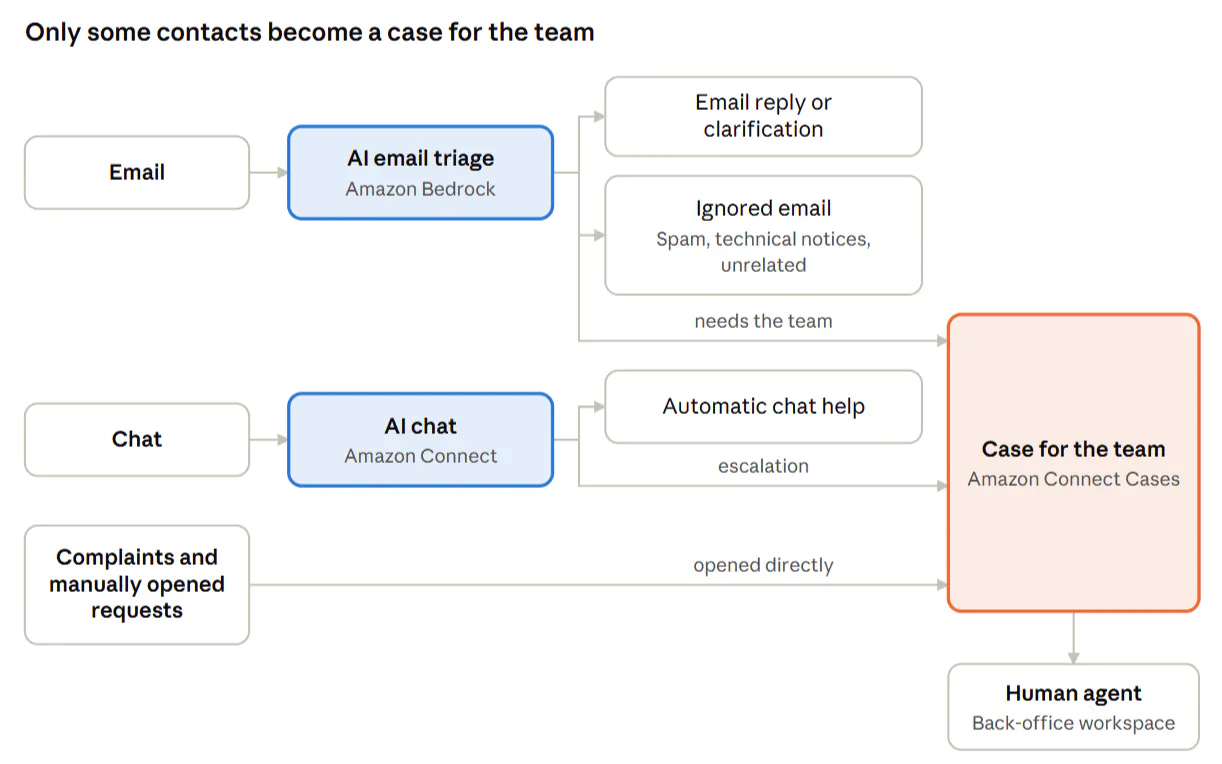
Email and chat have their own automatic handling paths. Requests that need a person are passed to the team as cases, while complaints and manually opened requests have a direct path into the support workspace.
Amazon Connect Cases as the system of record. Requests that need human follow-up are handled as cases in Amazon Connect, with a reference, conversation history and relevant merchant context. The cases stay connected to the tools our team uses in the back office.
AI email triage. AI identifies the request and uses our documentation to answer, ask for clarification or pass it to the team. It can also ignore spam, technical notifications and messages outside MONEI support. Automatic email replies are grounded in our documentation, and documentation links are checked before sending.
Protecting merchant information. We use masking rules and managed detection to protect sensitive information before AI processing. We also check generated responses and verify these safeguards regularly with automated checks. Requests that require verification remain with our team.
One knowledge base across channels. We unified our support and developer documentation through Amazon Bedrock Knowledge Bases. That gives email, chat and our team a shared source of guidance for customer support and internal work, which we can also reuse for future support channels.
Chat with an AI agent. An Amazon Connect AI agent answers in the merchant dashboard and on our public landing pages. When a request needs human help, the team receives the conversation and context.
The workbench in the back office. The support queue lives inside our back office, with the conversation and the merchant's profile beside it. The queue updates automatically as conversations change. When a request needs a person, the agent remains in control of the response. Additional internal AI tools help them work faster: they can translate the customer's request and their own reply, summarise the conversation, and refine the wording of a response before sending it.
How long it took
From the first work on Connect Cases to the support cutover took four months, with most support-specific work concentrated in the final six weeks leading up to the cutover. The initial back-office workbench was built in three days.
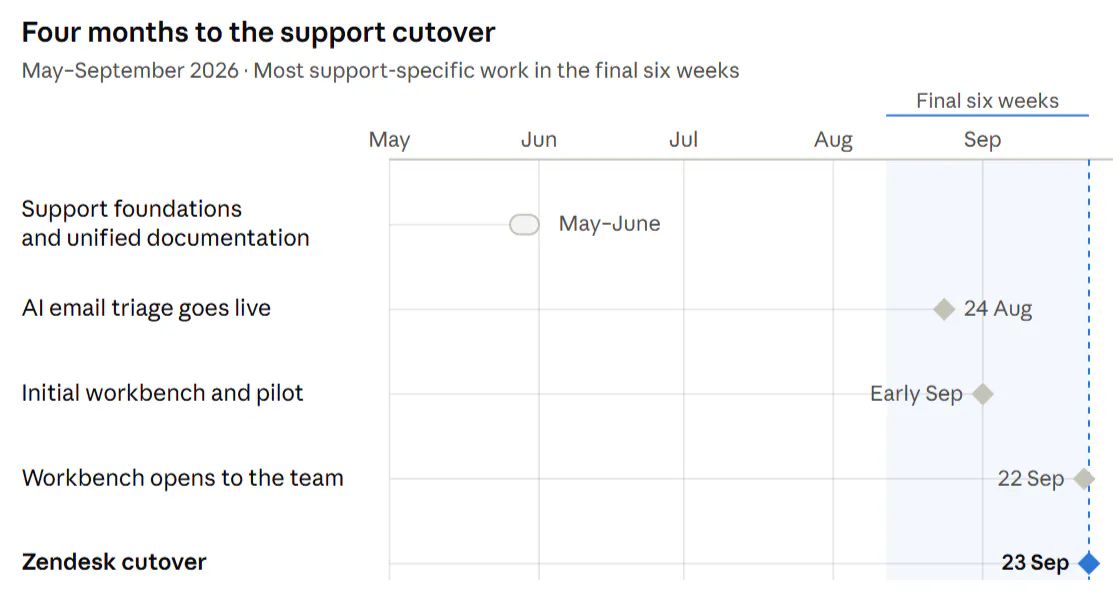
The main stages were unifying the documentation, testing automatic replies alongside Zendesk, and moving the team into the back office.
A few things worth mentioning:
- Connect was already in the house for another reason. MONEI was already using Amazon Connect for customer profiles and outbound communications. That existing foundation helped us add support.
- The documentation was the groundwork that made it possible. In May we brought the Zendesk Help Center into docs.monei.com in both English and Spanish, removed duplication and reviewed outdated information. That shared source of guidance became the foundation for AI support.
- AI went live before the front end. Automatic email triage was serving real traffic from 24 August while Zendesk still handled the team's queue. Running them in parallel gave us time to review routing and automatic answers before the Zendesk cutover on 23 September.
- The initial workbench was built in early September and tested with a small group before it opened to the team on 22 September.
Only 15 open conversations needed to be migrated. We recreated them in Amazon Connect with their conversation history so our team could continue responding by email. The handover took place outside working hours on 23 September, between 21:00 and 23:00 Madrid time. From then on, all support requests were managed in Connect. Our statistics begin on 24 September, the first full day after the cutover.
What we gained
Fewer support requests needing human attention. Between 24 September and 18 October 2026, 55.2% of all closed, meaningful support conversations related to MONEI were solved automatically. This measure covers automatically answered email threads and chat conversations, alongside tickets closed by the team. Separately, 58.1% of all email messages processed by triage were classified as IGNORED, including spam, technical notifications and requests outside MONEI support; these messages are excluded from the 55.2% figure.
Flexibility to choose the right AI. Amazon Bedrock lets us test and compare models on answer quality, speed and cost, then choose the best fit for each support task. As new models become available in Bedrock, we can evaluate and adopt them to keep improving the support experience.
A workspace designed for our needs. We tailored the workspace to MONEI's support processes, bringing conversations and investigation tools together in the back office our team already uses.
What we notice day to day:
- Context on the same screen. Agents can see the conversation alongside the merchant's account and use the back-office tools needed to investigate payments, settlements and other support questions.
- One place to keep guidance current. Support articles and developer documentation now share one English-and-Spanish hub for merchants, our team and AI. We also reviewed outdated prices and plans during the move. Improving an explanation in one place makes it available across support channels, and replies can link merchants to the source. Requests that need more investigation go to the team.
- A single route to support. One contact page replaces the Zendesk forms, with AI chat as the starting point and email available for anyone who prefers it.
- 24/7 multilingual support. Automatic email replies currently use English, Spanish, French and Catalan, with English as the fallback for other languages. We chose these four because our team speaks them, making it easier to review AI responses closely during the initial rollout. Once the foundation is established, we plan to expand the email language list significantly. Chat follows the customer's language when it can respond reliably, with an English fallback when needed. Requests involving risk, compliance, GDPR or verification still go to the team.
- Control over our support data. Keeping support statistics, conversation transcripts and related records in our own AWS environment gives us more control over how we store and use them. We can revisit older requests and analyse support in formats that suit MONEI, without first extracting the data through a third-party support platform's API.
- The whole team close to merchants. The support report is shared across the team, giving legal, content, SEO and engineering a common view of workload, automation and human handling.
What changes in the cost model
Zendesk combined agent subscriptions with AI usage billed through automated resolutions. The Amazon setup is billed through the services we use for conversations, cases and AI. These are different cost structures, and contact volume still matters.
- Zendesk (agent subscriptions + AI resolutions) - Before: €9,852 per year, After: €0
- Amazon Connect (support service only) - Before: €0, After: ≈€3,495 per year
- Amazon Bedrock (support service only) - Before: €0, After: ≈€1,044 per year
- TOTAL: Before: €9,852 per year, After: ≈€4,539 per year
The Zendesk total is based on invoices from October 2025 to September 2026, when we averaged about seven agent seats per month, with the number varying throughout the year. That already reflected cost optimisation, following a reduction from ten seats in 2024–2025.
The Amazon Connect and Bedrock figures are annual estimates based on three weeks of usage, from 24 September to 14 October 2026. For this comparison, we assume the same annual ticket volume in both systems.
What we learned
- Good documentation is the foundation of support. Clear, current guidance gives merchants, support staff and AI a better starting point for answering a question. Maintaining it is part of maintaining support.
- Deal with routine traffic early. The workflow filters automated notifications and unrelated traffic before it reaches the team, helping people focus on requests that need their attention.
- Good automation chooses the right next step. A useful response may answer the question, ask for missing information or bring in the right person. The workflow matters as much as the wording of the answer.
- Make privacy part of the workflow. We decide what information the AI needs, protect sensitive information before processing, and check generated responses before they reach a customer.
- Let the AI coexist with the old system. A month of automatic triage running alongside Zendesk gave us time to tune eligibility and escalation with real traffic and a safety net.
- Build on the tools your team already uses. A shared workspace brings the conversation and investigation tools together. Reusing an existing platform can make that practical without building every part of support from scratch.
- People and AI working together. When a request needs human help, our team reviews the situation, shapes the reply and decides what action to take. AI tools support that work with summaries, translations and reply refinement, helping the team respond faster and adapt to each merchant’s needs.
- A good handoff preserves the conversation. When a request moves from chat to email or from AI to a colleague, the history and relevant context should travel with it, helping merchants continue without repeating their explanation.
What comes next
The next priorities focus on expanding access to support and improving how it works. The documentation connection through MCP is already available.
- Find MONEI guidance in your preferred AI tools. Our documentation is already accessible through MCP (Model Context Protocol), allowing compatible AI assistants to search MONEI guidance directly. Merchants can find answers in their preferred AI tools, using the public documentation.
- Ask the chat assistant about your account. Get account-specific answers for active accounts, with read-only access and no changes to account settings.
- Get support through WhatsApp. Bring the same support experience to MONEI's WhatsApp, with verification before sharing account-specific information.
- Explore support by phone. Evaluate voice support through Amazon Connect, building on the conversations, cases and shared knowledge already in place.
- Keep improving support behind the scenes. Review answer quality, merchant feedback and costs, and changes against real support questions. Use the findings to improve workflows and documentation and expand language coverage.
If you have done a similar migration or are considering one, we would like to compare notes: write to us through docs.monei.com/contact-support/.

Varvara Andreeva
Data Engineer at MONEI


