



SaaS pricing strategies: how to choose the right model

Your SaaS pricing strategy decides more than what customers pay. It shapes who signs up, how quickly accounts grow, and how much revenue you keep each month. Yet many software companies set a price at launch and rarely revisit it.
That’s an expensive habit, and the numbers show it. Simon-Kucher’s 2025 Global Pricing Study surveyed more than 2,200 business leaders in 28 countries and found that, on average, companies realize less than half of their price increases. Getting pricing right takes a clear strategy, not a one-off decision.
This guide covers the main SaaS pricing models, how to choose what you charge for, how to package your plans, and how AI is changing the picture. You’ll also learn how to set up payments so the pricing you choose actually gets collected.
Table of contents
- What is a SaaS pricing strategy?
- Pricing model, value metric, and packaging
- The 6 most common SaaS pricing models
- How AI is changing SaaS pricing
- How to choose the right pricing model
- Packaging your plans: good-better-best
- Getting paid: subscriptions vs. one-off payments
- SaaS pricing best practices and mistakes to avoid
What is a SaaS pricing strategy?
A SaaS pricing strategy is your approach to setting, structuring, and adjusting the price of the software you sell as a service. It works on two levels:
- Pricing strategy is how you decide your price level. Examples include penetration pricing (start low to win market share), value-based pricing (price on what the product is worth to the customer), and premium pricing (price high to signal quality).
- A pricing model is how you structure the charge: per user, per unit of usage, per plan, or a mix.
SaaS pricing differs from pricing a physical product in three ways:
- Revenue is recurring. Customers decide every billing cycle whether your product is worth the price, so retention matters as much as winning the first sale.
- Serving one more customer costs very little. That makes cost-plus pricing a poor fit. Price on the value you deliver instead.
- Accounts can grow. A good pricing model lets revenue grow as customers use more of your product, without a new sales cycle.
Because of all three, SaaS pricing is never “done.” It’s something you review as your product and market change.
Pricing model, value metric, and packaging
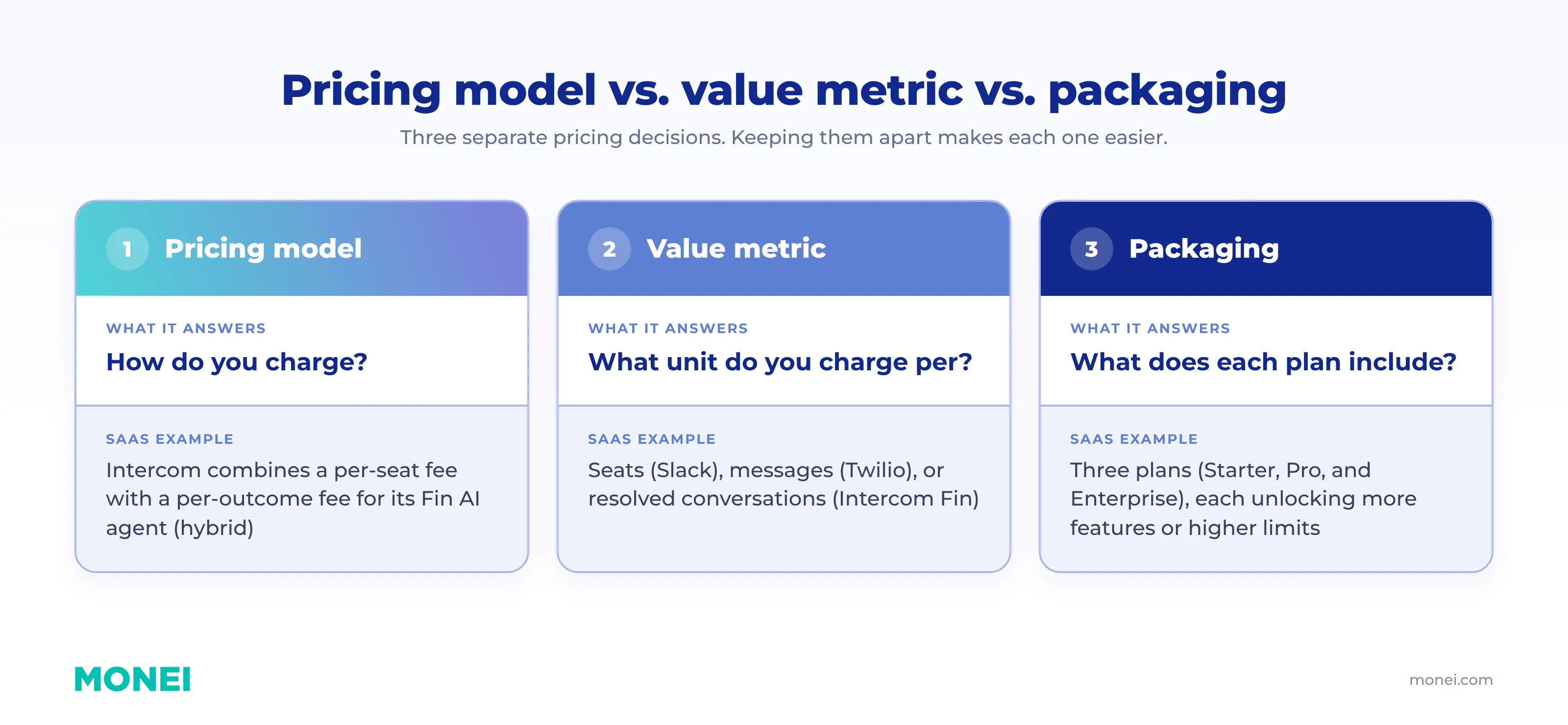
Most pricing conversations mix up three separate decisions. Keeping them apart makes each one easier:
- Pricing model. How you charge. For example, Intercom combines a per-seat fee with a per-outcome fee for its Fin AI agent, which makes it a hybrid model.
- Value metric. The unit you charge per, such as seats (Slack), messages (Twilio), or resolved conversations (Intercom Fin).
- Packaging. What each plan includes. A common setup is three plans (Starter, Pro, and Enterprise), each unlocking more features or higher limits.
The value metric is the one most companies skip, and it matters most. When it tracks the value customers get, revenue grows as they succeed. When it doesn’t, customers feel overcharged, or you leave money on the table.
To test a value metric, ask three questions:
- Does it grow as the customer gets more value? Number of invoices sent works for invoicing software. Number of logins usually doesn’t.
- Can customers understand and predict it? If they can’t estimate next month’s bill, they’ll hesitate to buy.
- Can you measure and bill it reliably? If you can’t track it accurately, you can’t charge for it.
The 6 most common SaaS pricing models
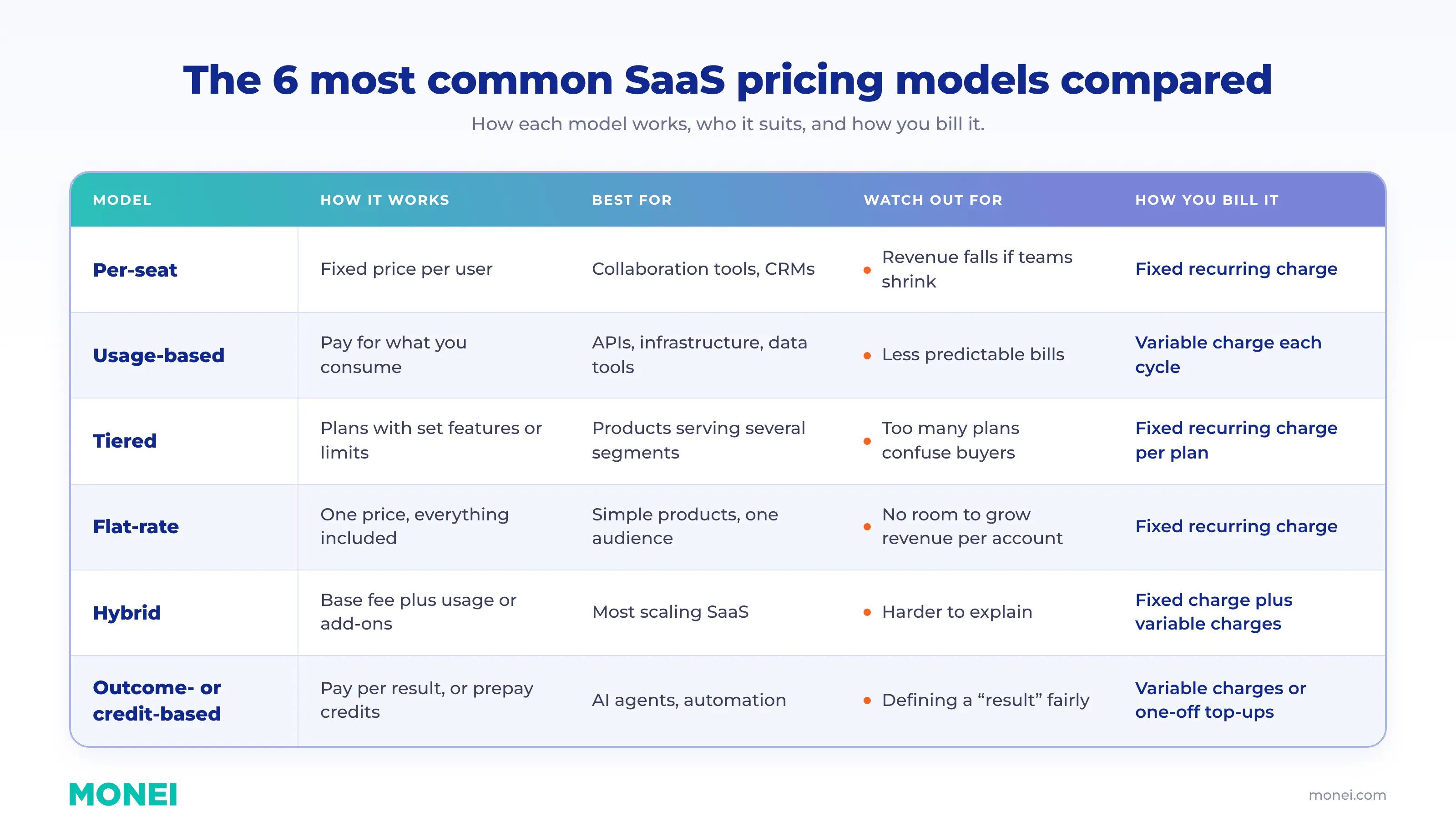
Here’s how the main SaaS pricing models compare at a glance, including how each one gets billed:
1. Per-seat pricing
You charge a fixed price per user each month. Slack is the classic example. It’s simple to understand and easy to forecast, and revenue grows as customers add people. The weakness is that if your product helps customers do the same work with fewer people, your revenue shrinks.
2. Usage-based pricing
Customers pay for what they consume, such as API calls, messages, or gigabytes stored. Twilio and AWS work this way. It’s becoming the norm: in a survey of 100 SaaS companies by Metronome, a usage-billing vendor, and its investor Greyhound Capital, 85% said they had adopted some form of usage-based pricing.
Usage pricing often comes with volume tiers, where the unit price drops as customers use more. Our payment gateway pricing works this way: the transaction fee starts at 0.90% + €0.25 and falls automatically as monthly volume grows, down to 0.15% above €5M.
3. Tiered pricing
You offer a few plans, each with more features or higher limits. Tiers let you serve a solo founder and a large team with the same product. Each tier should map to a clear customer segment, not just an arbitrary feature list.
4. Flat-rate pricing
One price, one plan, everything included. For example, Basecamp’s Pro Unlimited plan costs $299 a month for unlimited users. Flat-rate pricing is easy to sell, but you can’t earn more from the customers who get the most value.
5. Hybrid pricing
A predictable base fee combined with a usage or add-on component. Intercom charges per seat (from $29 per seat a month on annual billing) and adds $0.99 for each outcome its Fin AI agent delivers. Hybrid models give you a stable revenue base and still let revenue grow with usage.
6. Outcome-based and credit-based pricing
Outcome-based pricing charges for a result, such as a resolved ticket or a qualified lead. Credit-based pricing sells packs of credits upfront that customers spend on actions. Both are growing quickly in AI products, where the software does the work instead of a person.
What about freemium? Freemium is better thought of as an acquisition tactic than a pricing model. You can add a free plan to any of the models above to get people using your product before they pay.
How AI is changing SaaS pricing
AI puts pressure on traditional SaaS pricing in two ways:
- Fewer seats. If an AI agent does work that used to need five people, a per-seat model charges for one. The more value your AI delivers, the less you earn.
- Variable costs. Every AI request costs compute, and costs vary with task complexity. A flat fee can turn a heavy user into a loss.
The market is responding. Gartner predicts at least 40% of enterprise SaaS spending will shift toward usage-, agent-, or outcome-based pricing by 2030, as reported by CIO.
This is also pushing SaaS pricing toward a more dynamic model, where prices adjust with usage, cost, or volume rather than staying fixed. In practice, that means credit packs, usage caps with overage fees, and volume-based discounts. If you sell AI features, pairing a base subscription with a usage component is usually the safest place to start.
How to choose the right pricing model
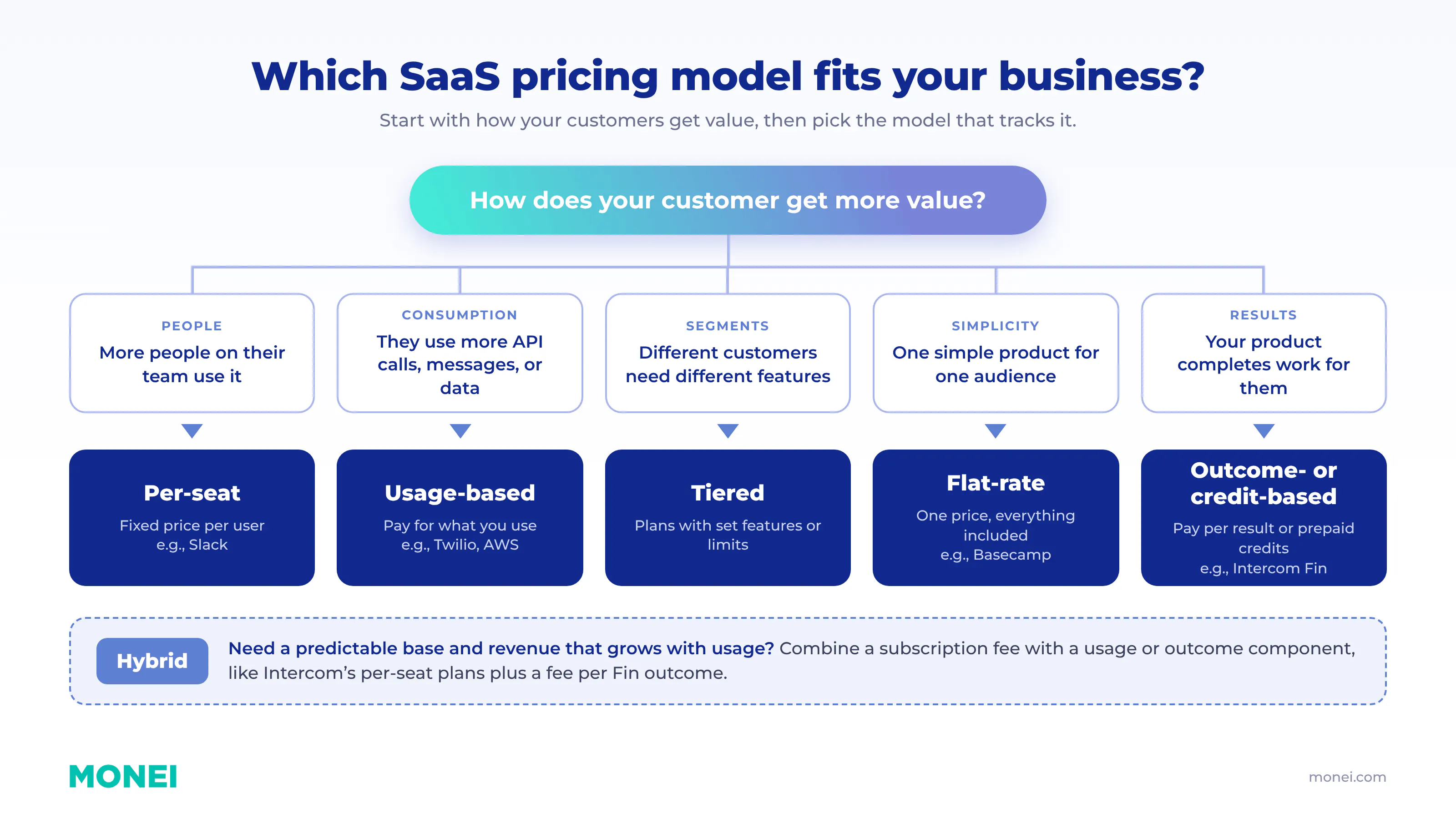
Start with how your customers get value, then pick the model that tracks it:
- If value grows with the number of people using the product, consider per-seat pricing
- If value grows with consumption (API calls, messages, data), consider usage-based pricing
- If you serve clearly different customer segments, consider tiered pricing
- If your product is simple and serves one audience, consider flat-rate pricing
- If you need a predictable base but want revenue to grow with usage, consider hybrid pricing
- If your product completes work on the customer’s behalf, consider outcome- or credit-based pricing
Your business stage matters too:
- Early stage. Keep it simple with two or three plans and one clear value metric. Talk to customers before you add complexity.
- Scaling. Add an expansion path, such as usage add-ons or higher tiers, and offer annual plans to improve cash flow.
- Enterprise. Expect custom contracts, committed spend, and volume discounts. Keep your public pricing as the reference point.
Packaging your plans: good-better-best
Once you’ve chosen a model, you need to decide what goes into each plan. The most common structure is good-better-best: three tiers that match three types of customers.
- Good. The entry plan. Enough to solve the core problem for small teams or new users.
- Better. The plan you want most customers on. Highlight it as “most popular.”
- Best. The advanced plan for large teams, with higher limits, admin controls, and priority support. Often requires potential and existing users to “Contact sales.”
A few tactics make this structure work harder:
- Anchor high. Showing the top plan first makes the middle plan look like good value.
- Use limits, not just features. Usage caps or seat limits give customers a natural reason to upgrade as they grow.
- Reward annual billing. Intercom’s entry plan costs $29 per seat per month billed annually versus $39 billed monthly, about 25% less. This kind of structure gives you cash upfront and lowers churn.
- Try a reverse trial. Give new users the top plan for a limited time, then move them to the plan they choose. They’ll know exactly what they give up by downgrading.
Getting paid: subscriptions vs. one-off payments
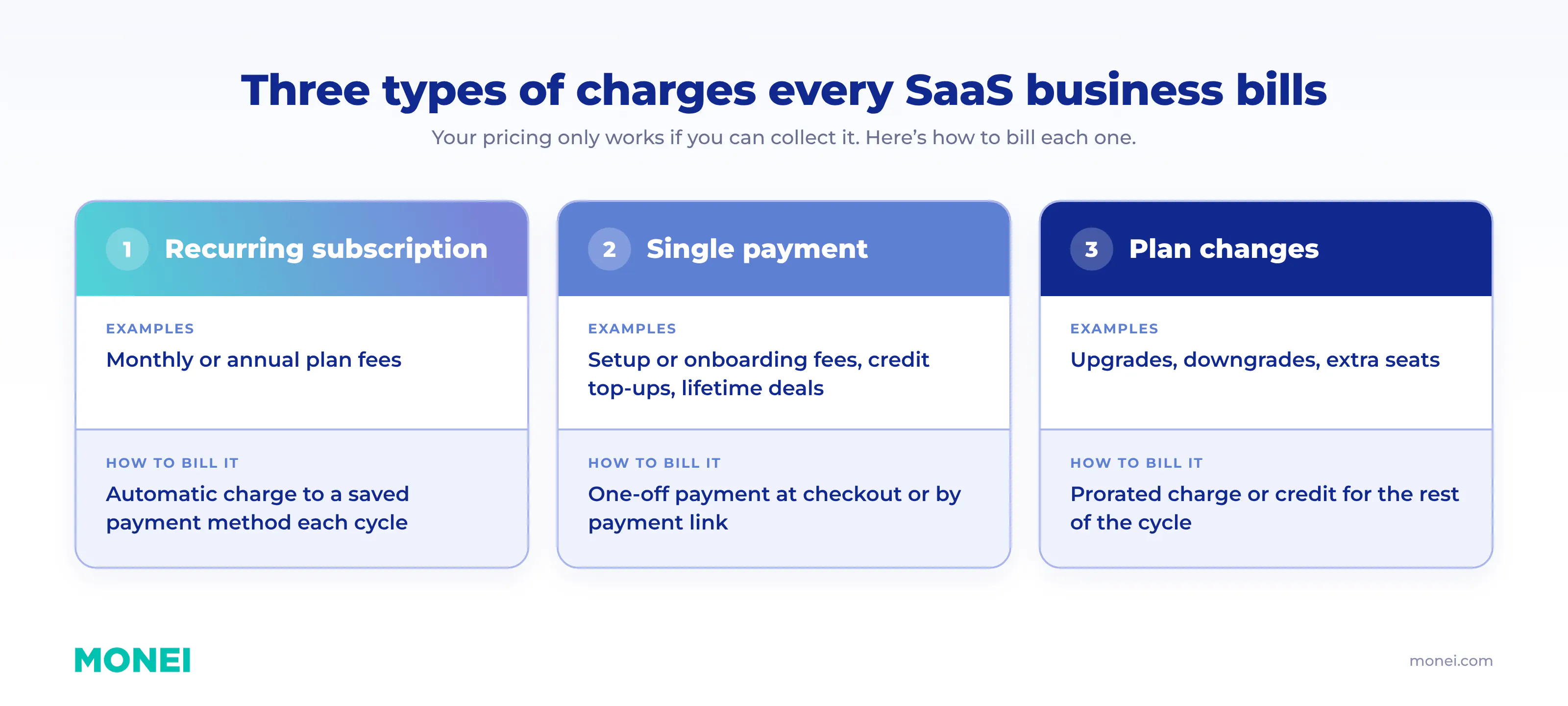
Most SaaS businesses need to handle several kinds of charges:
- Recurring subscriptions. Monthly or annual plan fees, charged automatically to the customer’s saved payment method each billing cycle.
- Single payments. One-off charges such as setup or onboarding fees, credit top-ups, and lifetime deals, collected at checkout or through a payment link.
- Plan changes. Upgrades, downgrades, and extra seats, billed as a prorated charge or credit for the rest of the billing cycle.
SaaS pricing best practices and mistakes to avoid
Do
- Price on the value customers get
- Review pricing at least once a year, and test changes on new customers first
- Give existing customers notice or keep them on their current price for a while
- Keep plans easy to compare at a glance
- Tie discounts to commitments, such as annual billing
- Track net revenue retention, ARPU, and involuntary churn
Don’t
- Set prices by adding a margin to your costs
- Set your price at launch and forget it
- Surprise loyal customers with sudden price rises
- Offer so many plans that buyers can’t choose
- Offer deep, permanent discounts that reset your price
- Treat failed payments as a cost you can’t control
The biggest hidden risk is failed payments
Expired cards and insufficient funds quietly cancel customers who never meant to leave. Recurly’s benchmarks put SaaS involuntary churn at 1.06% a month, about a third of total monthly churn of 3.22%. You can often recover that revenue with the right setup.
With MONEI Subscriptions, you can:
- Bill on any cycle. Charge daily, weekly, monthly, or yearly, with optional free trial periods.
- Change plans fairly. Apply plan changes from the next billing period, or prorate them from today.
- Recover failed payments automatically. By default, MONEI retries failed monthly payments 1, 6, and 15 days later and can email customers when their subscription status changes. You can also set your own retry schedule.
- Give customers flexibility. Pause subscriptions, or cancel at the end of the billing period so customers keep access until then.
- Accept the payment methods customers prefer, including cards, Apple Pay, Google Pay, Click to Pay, and Bizum.
- Track MRR and churn in real time from your MONEI dashboard.
📌Try our free subscription pricing simulator to see what you can earn after costs on yearly vs monthly subscriptions.
For one-off charges such as setup fees or credit top-ups, you can take a single payment through the same MONEI account. Our SaaS payment gateway has no setup fee and no monthly minimum, and your transaction fees drop as your sales volume grows (available to businesses operating in Spain and Andorra).
Put your SaaS pricing strategy to work
There’s no perfect SaaS pricing model, only the one that fits how your customers get value. Start with your value metric, choose the model that tracks it, and package it into a few clear plans. Then keep reviewing it, especially as AI changes how customers use and pay for software.
Whichever model you choose, your pricing only pays off if you can collect the funds. A payments setup that handles recurring subscriptions, one-off charges, and failed payments protects the revenue your pricing earns. MONEI gives SaaS businesses exactly that, with fees that drop as you grow.
SaaS pricing frequently asked questions
There’s no single best model. The right one tracks how your customers get value. Many growing SaaS companies use a hybrid: a predictable subscription fee plus a usage-based component that grows with the customer.
Start with the value your product creates for customers, such as time saved, revenue gained, or costs avoided. Then check competitor prices and test with real buyers. If no prospect ever says your product is expensive, your price is probably too low.
A value metric is the unit you charge for, such as users, API calls, contacts, or resolved tickets. A good value metric grows as customers get more value from your product, so revenue grows with them.
Review it at least once a year, and whenever you launch major features, enter a new market, or see your costs change. Test changes on new customers before rolling them out to your existing base.

Alexis Damen
Alexis Damen is a former Shopify merchant turned content marketer. Here, she breaks down complex topics about payments, e-commerce, and retail to help you succeed (with MONEI as your payments partner, of course).


