


Pricing strategies: What is the best for your business?

Pricing strategies decide much more than the number on your price tag. They shape how customers see your brand, how much margin you keep on every sale, and how quickly your business grows. Set prices too high, and buyers go elsewhere. Set them too low, and you leave money on the table or struggle to cover your costs.
Getting it right is harder than it looks. According to Simon-Kucher's Global Pricing Study 2025, a survey of more than 2,200 business leaders in 28 countries, companies keep less than half of the price increases they try to make, on average. Without a clear strategy, a price rise can turn into lost customers, extra discounts, or both.
In this guide, you'll learn the most common pricing strategies, which businesses each one suits, and how to choose the right one for yours.
Table of contents
- What is pricing (and what is a pricing strategy)?
- Why a good pricing strategy matters
- Factors to consider before setting prices
- 10 common pricing strategies and the businesses they suit best
- How pricing strategies vary by type of business
- How sales channel affects your pricing: online, in-store, and omnichannel
- How payment costs influence your pricing strategy
- How to choose the best pricing strategy for your business
- Common pricing mistakes to avoid
- Putting your pricing strategy into action
What is pricing (and what is a pricing strategy)?
Pricing is the process of deciding how much to charge for a product or service. It requires balancing three things: what the product costs you, what customers are willing to pay, and what competitors charge.
A pricing strategy is the method you use to set and adjust those prices to reach a business goal. That goal could be winning market share, maximizing profit, clearing stock, or positioning your brand as premium. Your strategy should change as your costs, customers, and market evolve.
It helps to separate three terms that often get mixed up:
- Price is the amount a customer pays, for example, €29.
- Pricing strategy is the logic behind the price, for example, matching competitors or charging based on the value customers perceive.
- Pricing model refers to how you charge, for example, one-time payment, subscription, or pay-per-use.
Pricing strategy vs. pricing model
Your pricing strategy sets how much you charge. Your pricing model sets how and when customers pay. Most businesses use one of three:
- One-time payments. Customers pay once for a product or service. This model is simple and familiar, and it suits most retail, hospitality, and e-commerce businesses. The challenge is that you need to win every sale again, so repeat purchases (i.e., increased customer lifetime value), upsells, and loyalty programs matter.
📌 Let customers spread the cost of a one-time purchase while you still get paid upfront, making higher-priced items easier to sell with MONEI Flex, our buy now, pay later solution.
- Subscriptions. Customers pay a recurring fee, usually monthly or yearly. You get predictable subscription revenue and a longer relationship with each customer. In return, you have to keep delivering value to keep churn low. Free trials, freemium plans, and annual discounts can help you win and keep subscribers.
- Hybrid models. Many businesses combine both models. A coffee shop might sell single drinks and a monthly coffee pass. A gym might offer drop-in classes alongside memberships.
Why a good pricing strategy matters
Price is often the first thing customers compare, and right now they're paying close attention. According to McKinsey's State of the Consumer 2025, consumers’ expectations for value and convenience are driving unexpected trade-offs across categories: trading down in one place while splurging on something else, which makes it hard to predict what consumers will do next. That’s why developing a pricing strategy is crucial.
A clear pricing strategy helps you:
- Protect your margins. You know every sale covers your costs and leaves you a profit.
- Position your brand. Price signals quality: if you charge too little, customers may doubt your product; if you charge too much, they'll expect a premium experience.
- Win and keep customers. The right price attracts the buyers you want and gives them a reason to come back.
- Plan for growth. Consistent pricing makes revenue easier to forecast, so you can invest with more confidence.
Factors to consider before setting prices
Before you pick a pricing strategy, look at the factors that decide what you can, and should, charge.
Costs
Your costs set the minimum price you can charge without losing money. Include fixed costs (rent, salaries, software) and variable costs (materials, shipping, packaging, payment processing fees).
For example, if a product costs you €12 and you want a 40% margin, the price works out as €12 ÷ (1 − 0.40) = €20. In the EU, prices shown to consumers must include VAT, so add it on top.
Perceived value
What customers are willing to pay sets your upper limit. That depends on how much they value the problem you solve, the quality and convenience you offer, and your brand.
Competition
Competitors' prices act as a reference point for customers. You don't have to match them, but you need a clear reason for charging more or less.
Product lifecycle
Products you stock all year need a stable price with occasional promotions, so customers trust what they pay. Seasonal or limited-edition items can start higher while demand peaks, with planned markdowns to clear stock before the season ends.
Business goals
Your goal shapes your price. Winning market share often means lower prices, while maximizing profit or building a premium brand means higher ones.
10 common pricing strategies and the businesses they suit best
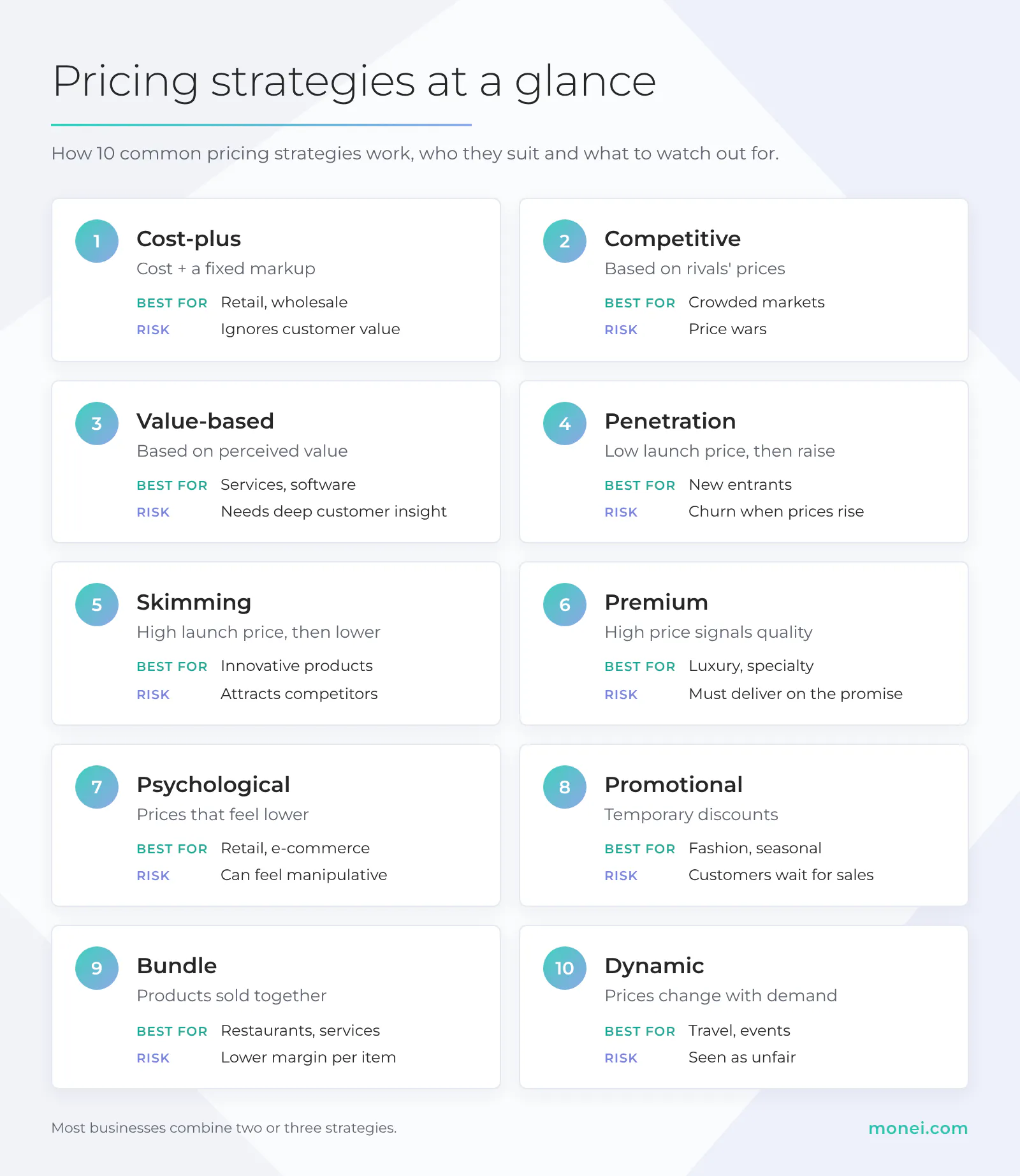
There's no single right pricing strategy, and most businesses combine two or three. Here are the 10 most common.
1. Cost-plus pricing
You add a fixed markup to the product's cost. It's simple and protects your margin, but it ignores what customers are willing to pay.
Best for: retailers, wholesalers, and manufacturers with stable costs.
2. Competitive pricing
You set prices at, below, or just above your competitors'. It works when customers compare similar products side by side.
Best for: crowded markets such as consumer electronics or everyday goods sold online.
3. Value-based pricing
You price based on how much the customer values the result, not on your costs. It can bring higher margins but requires a strong understanding of your customers.
Best for: professional services, software, and clearly differentiated products.
4. Penetration pricing
You launch at a low price to win customers quickly, then raise it over time. The risk is losing price-sensitive customers as prices rise.
Best for: new brands entering established markets and new subscription services.
5. Price skimming
You launch at a high price for early adopters, then lower it as demand settles. Tech brands often do this with new phones and gadgets.
Best for: innovative products with strong demand at launch.
6. Premium pricing
You keep prices high to signal quality and exclusivity. The product, service, and brand experience have to justify it.
Best for: luxury goods, specialty food, and boutique hotels.
7. Psychological pricing
You use prices that feel lower or more attractive, such as €9.99 instead of €10, or showing a higher-priced option next to the one you want to sell.
Best for: retail and e-commerce, especially lower-priced and impulse purchases.
8. Promotional pricing
You offer temporary discounts, flash sales, or seasonal offers to attract customers or clear stock. Used too often, it teaches customers to wait for the next sale.
Best for: fashion, retail, and seasonal businesses.
9. Bundle pricing
You sell several products or services together for less than they'd cost separately. It increases the average order value and helps move slower-selling items.
Best for: restaurants, e-commerce stores, and service packages.
10. Dynamic pricing
Prices change based on demand, time, stock levels, or competitor prices, often automatically. It maximizes revenue but can upset customers if it feels unfair.
Best for: travel, hospitality, events, and large online stores.
How pricing strategies vary by type of business
No single pricing strategy works for every business. The right one depends on your sector, your margins, how often customers buy, and how they pay. Here's how pricing typically works in some of the most common business types.
- Retail and e-commerce. Shoppers can compare prices in seconds, so retailers often combine competitive, psychological, and promotional pricing. Large online stores increasingly use dynamic pricing, and peak sales events like Black Friday call for a clear discount plan.
- Restaurants and hospitality. Most restaurants start with cost-plus pricing based on food costs. They then use bundles, such as set menus, and off-peak offers to fill quieter hours.
- Hotels and travel. Demand changes by season, day of the week, and even hour, so dynamic pricing and revenue management are standard. Rates usually rise as availability drops.
- Services and appointments. Hair salons, clinics, gyms, and freelancers often use value-based pricing. Packages and memberships encourage repeat visits.
- Subscription businesses and SaaS. Software companies and online education platforms typically offer tiered plans with different features at each level, often alongside freemium options and annual discounts.
- Events and ticketing. Early-bird, tiered, and dynamic pricing are common. Sudden price spikes can damage your reputation, though, as the backlash over dynamic ticket prices for Bruce Springsteen's 2023 tour showed.
- B2B and wholesale. Prices are often negotiated, and volume discounts and payment terms matter as much as the price itself. Sending a payment link with each invoice makes it easier to get paid on time.
How sales channel affects your pricing: online, in-store, and omnichannel
Where you sell changes how customers see your prices.
Online: transparency and easy comparison
Online shoppers can compare prices in a few clicks, so small differences matter more. Hidden costs hurt the most. According to the Baymard Institute, 40% of shoppers abandon their carts because extra costs, such as shipping, taxes, or fees, are too high. Show the full price early to avoid cart abandonment at checkout.
In-store: local competition and perceived value
In a physical shop, customers compare you with nearby competitors rather than the whole internet. The store experience, staff advice, and being able to take the product home immediately all add perceived value, which can justify slightly higher prices.
Omnichannel: consistent prices across channels
If you sell both online and in-store, customers expect the same price everywhere. If prices differ, have a clear reason, such as an online-only promotion. Consistent pricing builds trust and supports an omnichannel retail strategy.
🚀 MONEI’s omnichannel payment features help your business grow.
How payment costs influence your pricing strategy
Every card or digital payment comes with a fee, and those fees cut into your margin. Since you can't add a surcharge for most consumer cards in the EU, payment costs need to be part of your pricing from the start.
Understanding payment fee structures
Payment providers usually charge in one of two ways:
- Flat or blended rate. You pay the same percentage on every transaction, sometimes plus a fixed fee. It's easy to budget for, but you may pay more than the real cost of some payments.
- Interchange++. You pay the interchange fee set by the card's issuing bank, plus card scheme fees and your provider's margin. It's more transparent, and often cheaper for businesses with higher sales volumes.
Why fixed fees matter more on small purchases
Take a hypothetical fee of 1.5% + €0.25 per transaction. On a €200 sale, you pay €3.25, or 1.6% of the price. On a €10 sale, you pay €0.40, or 4%. If you sell low-priced items, factor this in, or encourage larger baskets with bundles.
👉 Did you know? Payment processing fees don't have to stay fixed as you grow. With MONEI's volume-based pricing, your per-transaction rate drops as your monthly sales increase. The more you sell, the less each payment costs you, and the more margin you keep.
Your payment method mix
Different payment methods cost different amounts. Cards from outside the EU usually carry higher cross-border fees, while local payment methods such as Bizum can lower costs and increase conversion. To estimate what card payments really cost you, try an interchange fee calculator.
How to choose the best pricing strategy for your business
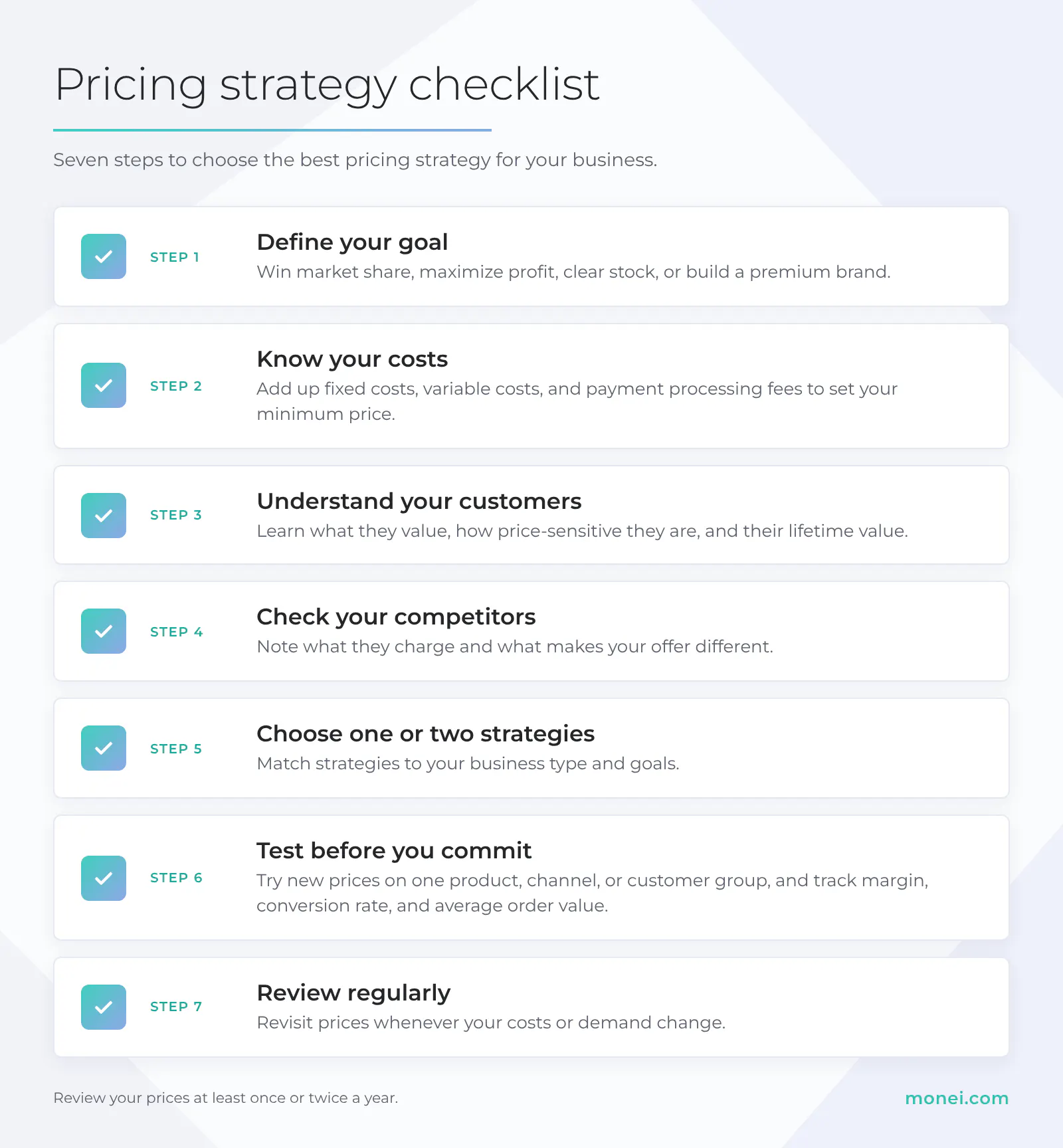
Use these steps to find the right pricing strategy, or the right combination of strategies, for your business:
- Define your goal. Decide whether you want to win market share, maximize profit, clear stock, or build a premium brand.
- Know your costs. Add up your fixed costs, variable costs, and payment processing fees to find the lowest price you can charge.
- Understand your customers. Find out what they value, how price-sensitive they are, and how much each one is worth over time (their lifetime value).
- Check your competitors. Note what they charge and what makes your offer different.
- Choose one or two strategies. Use the table above to match strategies to your business type and goals.
- Test before you commit. Try new prices on one product, channel, or customer group first, and track margin, conversion rate, and average order value.
- Review regularly. Revisit your prices at least once or twice a year, and whenever your costs or demand change.
Common pricing mistakes to avoid
Pricing only based on competitors. Matching competitors' prices ignores your own costs and what makes you different. You could end up in a price war you can't afford, or undercharge for a better product.
Not counting all your costs. Payment fees, shipping, returns, and chargebacks are easy to overlook, and they all eat into your margin.
Over-discounting. Frequent discounts train customers to wait for the next sale and can make your brand look cheap. Use promotions with a clear goal and an end date.
Charging different prices across channels without a reason. Unexplained price differences between your website, marketplaces, and store confuse customers and damage trust, especially in omnichannel commerce.
Raising prices without warning. Tell customers about price increases in advance and explain what they're getting for the money, especially subscribers.
Never testing or reviewing prices. Your costs, customers, and competitors keep changing, so your prices should too.
Putting your pricing strategy into action
The best pricing strategies cover your costs, reflect the value customers see, and change as your business grows. You don't need to get it perfect on day one. You need a clear starting point and the habit of reviewing it.
- Calculate your true costs. Include payment fees, shipping, and returns for your best-selling products.
- Pick one strategy to test. Choose one that fits your goal, and try it on a single product or channel.
- Set a review date. Put a date in your calendar to check margin, conversion rate, and average order value.
Small, regular adjustments add up to a stronger, more profitable business.
Sources used:
- The State of Pricing 2025 - Simon Kucher
- State of the Consumer 2025: When disruption becomes permanent - McKinsey
- Data-driven pricing: unlocking profits with the right mix of data, tech, people and values - IESE Business School
- 50 Cart Abandonment Rate Statistics 2026 - Baymard Institute
Pricing strategies frequently asked questions
Cost-plus pricing is the most common, because it's simple: you add a fixed markup to what the product costs you. Many businesses combine it with competitive or psychological pricing.
At least once or twice a year, and whenever your costs, demand, or competitors change significantly. Subscription businesses should also review prices before renewal periods.
In the EU, no, not for most consumer cards. PSD2 bans surcharges on consumer debit and credit card payments, so you need to build payment costs into your prices.
In most cases, yes. Customers expect consistent prices across channels, and differences without a clear reason can damage trust. If you do charge differently, such as with an online-only promotion, make it clear. Omnichannel payments make it easier to keep pricing and the checkout experience consistent everywhere you sell.
Give customers advance notice, explain what they're getting for the money, and consider small, gradual increases rather than one big jump. For subscriptions, you can keep current subscribers on their existing price for a set period to reduce churn.

Alexis Damen
Alexis Damen is a former Shopify merchant turned content marketer. Here, she breaks down complex topics about payments, e-commerce, and retail to help you succeed (with MONEI as your payments partner, of course).