


Cart abandonment: what it is, why it happens, and how to reduce it

Nearly seven out of every ten online shopping carts are abandoned before checkout is complete, according to the Baymard Institute's ongoing analysis of e-commerce data. For online stores, that adds up to billions of dollars in sales that almost happen.
Cart abandonment happens when a shopper adds an item to their cart, or starts the checkout process, and leaves before completing the purchase. It's different from a simple bounce, where someone never engages with the cart at all. An abandoned cart means someone showed real intent to buy, then hit a wall of friction, cost, or hesitation that changed their mind.
This guide covers what causes cart abandonment, how to calculate your store's cart abandonment rate, the latest benchmark data, and the practical steps to prevent, recover, and reduce abandoned shopping carts.
In this article, you’ll find answers to the following questions:
- What is cart abandonment?
- What is your cart abandonment rate, and how do you calculate it?
- What is the average cart abandonment rate?
- Why do shoppers abandon their carts? Top causes
- What cart abandonment reveals about your business
- How to reduce cart abandonment
- How to recover carts that are already abandoned
- How MONEI helps reduce cart abandonment
What is cart abandonment?
Cart abandonment is what happens when a shopper adds one or more items to their online cart, and even begins the checkout process, but leaves your e-commerce website without completing the purchase. The item stays behind in an abandoned cart while the sale itself never closes.
It's worth separating cart abandonment from browse abandonment, which describes visitors who leave without ever adding anything to their cart. Browse abandonment usually points to product, pricing, or traffic-quality issues further up the funnel. Cart abandonment is a narrower, more urgent signal that someone got close enough to buying that they picked a product, and something between that moment and the final click made them stop.
Not every abandoned cart represents a lost sale, though. Plenty of shoppers use the cart as an informal wishlist—a way to save items, compare prices across sites, or wait for a better moment (or a discount) before committing. Understanding which of these is happening at your store shapes which fixes are worth pursuing first.
What is your cart abandonment rate, and how do you calculate it?
Cart abandonment rate is the percentage of shoppers who add items to their cart but don't complete the purchase. You can use it to track, benchmark, and improve.
The formula: Cart abandonment rate = (1 − completed orders ÷ carts created) × 100
For example, if your store saw 700 carts started in a month and 350 of those turned into completed orders, you'd divide 350 by 700 to get 0.5, subtract that from 1 to get 0.5, then multiply by 100 for a 50% cart abandonment rate.
Most e-commerce platforms like Shopify, WooCommerce, PrestaShop, and similar all track it. Check it regularly because your own trend over time matters more than any external benchmark.
What is the average cart abandonment rate?
The most widely cited figure comes from the Baymard Institute, which averages results from 50 separate studies to put the overall cart abandonment rate at 70.22%. For every ten shoppers who start checkout, roughly seven leave without finishing.
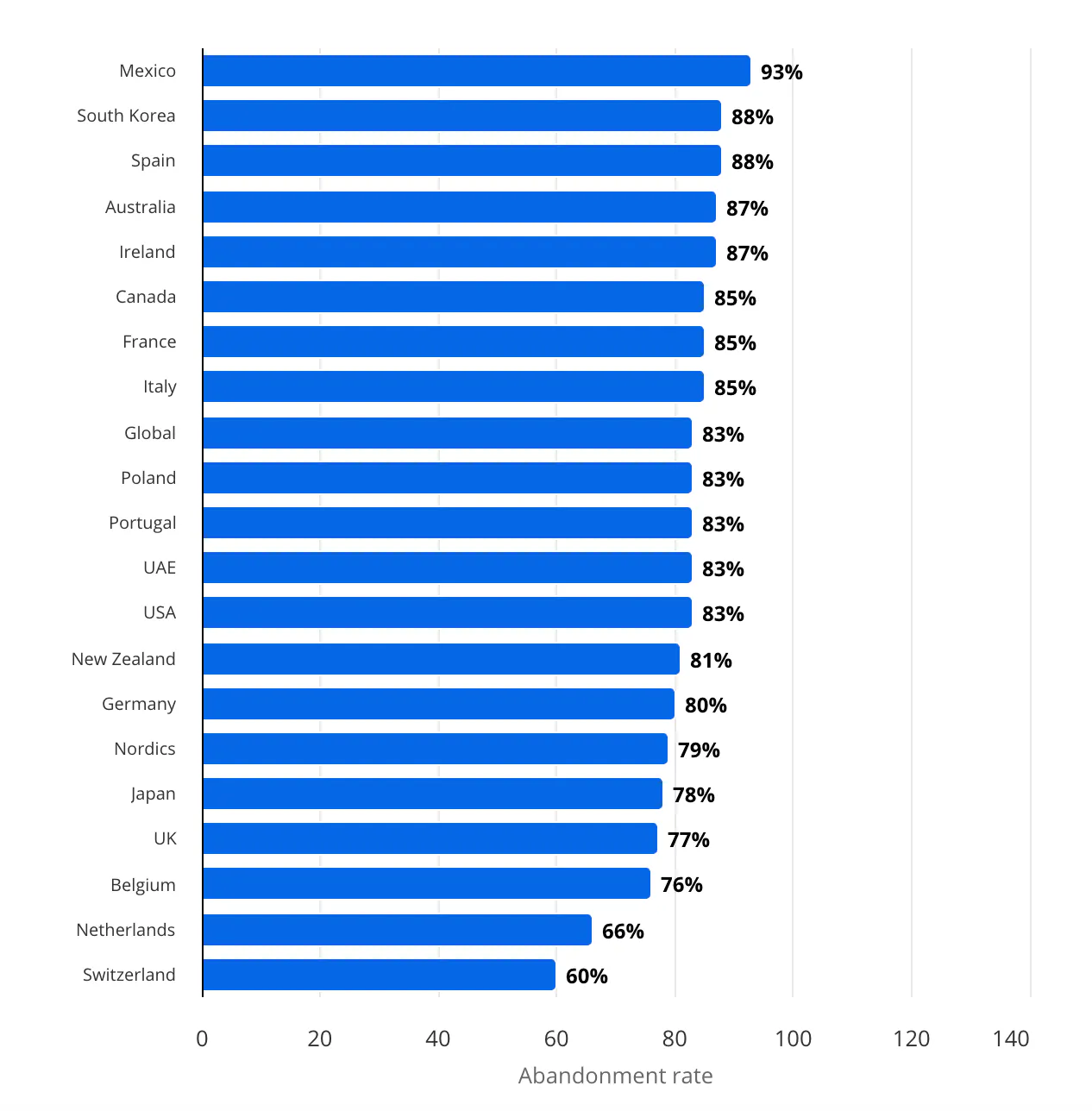
According to Statista, at the beginning of this year, shopping cart abandonment was most prevalent in Mexico, at a rate of 93%. South Korea and Spain were second-ranked, with 88% of carts abandoned instead of leading to a purchase.
According to Dynamic Yield's live benchmark data across its retail network (trailing twelve months), mobile shoppers abandon at 79.92%, versus 72.31% on tablet and 69.19% on desktop, which is a good reminder that your checkout must be mobile-friendly.
Industry matters too. Over that same period, Beauty & Personal Care saw the highest cart abandonment rate of any tracked category (79.81%), while Pet Care & Veterinary Services saw the lowest (51.1%), per the same Dynamic Yield benchmark.
Understanding why people abandon is more useful than the headline rate, though. Baymard's own reasons-for-abandonment research found that 42% of shoppers cite simply "browsing, not ready to buy"—a largely unavoidable share. Looking past that group, the top preventable reasons were:
- 40% - extra costs too high (shipping, tax, fees)
- 20% - delivery too slow
- 19% - didn't trust the site with credit card information
- 18% - site required account creation
- 17% - checkout process too long or complicated
- 17% - site errors or crashes
None of these numbers matter as much as your own. Track your store's cart abandonment rate over time, and treat industry and device benchmarks as context for interpreting it, rather than a target to hit.
Why do shoppers abandon their carts? Top causes
- Unexpected costs. Shipping fees, taxes, or handling charges that only appear at the final step feel like a bait-and-switch, even when they're standard. Shoppers who assumed a price included everything will often abandon on principle alone.
- A complicated or lengthy checkout. Extra form fields, unnecessary steps, or a process that isn't clearly moving toward completion give shoppers more opportunities to lose momentum, get distracted, or simply give up.
- Mandatory account creation. Being forced to register before buying adds friction and raises privacy concerns, especially for first-time or one-off shoppers who have no interest in a long-term relationship with the store.
- Limited or missing payment methods. If a shopper's preferred way to pay—a specific card network, a digital wallet, a buy now, pay later option, or a local payment method common in their country—isn't available, they may abandon rather than switch to something less convenient or trusted.
- Security and trust concerns. Without visible signals like a secure checkout badge, clear seller information, or recognizable payment logos, shoppers can hesitate to hand over card details, particularly on lesser-known or first-time sites.
- Slow performance or technical errors. A checkout page that lags, a payment that fails to process, or an error message at the worst possible moment will push away even a determined buyer.
- An unclear return or refund policy. When shoppers can't easily find out how returns work, they're left uncertain about the downside of a bad purchase, which makes it easier to hesitate and leave.
- Out-of-stock items discovered at checkout. Nothing kills momentum like adding an item to a cart only to learn at the final step that it's unavailable. The shopper has to start over, and they often go somewhere else.
- Just browsing or comparing. Not every abandoned cart is a failure. Some shoppers use the cart to save items, compare prices across sites, or wait for a better moment to buy. This is behavior that no checkout fix can eliminate.
What cart abandonment reveals about your business
It's tempting to treat every abandoned cart as simply a missed sale. But abandonment is also diagnostic and signals where your store's experience, pricing, and payment setup are creating friction, long before any single shopper decides to leave.
- A CX friction signal. A high abandonment rate, especially concentrated at a specific checkout step, usually means the path to purchase has too many steps, too much required information, or a mobile experience that wasn't designed with the same care as desktop. The cart is often the first place this friction becomes visible in the data.
- A pricing and value perception gap. If shoppers consistently add items and then leave once they see the full cost, that's worth investigating on its own, not just as a checkout problem. It can mean hidden costs are appearing too late, or that the total price no longer feels like a good deal once shipping and taxes are added.
- A payment process bottleneck. Abandonment concentrated at the online payment step specifically, rather than earlier in checkout, often points to too few payment methods, a clunky or unfamiliar payment page, or friction in how card and wallet details are collected.
- A trust deficit. Shoppers who reach checkout but stop short of entering payment details are sometimes making a judgment call about whether the store is safe to buy from. Missing reviews, no visible security signals, or an unfamiliar checkout page can all read as risk, even when nothing is actually wrong.
- Wasted marketing spend. Every abandoned cart represents traffic you already paid to acquire, through ads, SEO, or email, that came within one step of converting and didn't. A high abandonment rate doesn't just cost the sale; it erodes the return on every channel that drove that shopper to your site in the first place.
Read together, these signals turn cart abandonment from a single frustrating metric into a diagnostic tool: the pattern of where and when shoppers leave tells you which part of the buying experience to fix first.
How to reduce cart abandonment
Preventing abandonment beats recovering it. Here are a few ways to fix the friction before someone leaves, so you don't need to win them back at all.
Simplify and shorten checkout
Every extra field, click, or required step is another chance for a shopper to stall. Offer guest checkout so first-time buyers aren't forced to register, trim form fields down to what you actually need, and use a progress indicator so shoppers can see how close they are to done. Autofill for addresses and payment details removes typing, and one-click or tokenized checkout, where returning customers' payment details are securely stored and reused, can turn a multi-step process into a single tap.
Show all costs upfront
Shipping costs, taxes, and fees that only appear at the final step are one of the most consistently cited reasons for abandonment. Display these costs as early as the cart page, not just at checkout. If free shipping isn't feasible on every order, consider a spend threshold that unlocks it, and where possible, favor simple, all-inclusive pricing over a total that grows with each step.
Offer the payment methods shoppers actually want
A shopper who reaches checkout ready to buy will still leave if their preferred way to pay isn't available. That means going beyond standard cards to include digital wallets like Apple Pay and Google Pay, buy now, pay later options, Bizum, and payment methods that are popular locally but rarely offered by international platforms. This is one of the more overlooked levers in cart abandonment, since it's rarely about the shopper's willingness to buy and entirely about whether checkout speaks their preferred payment language. It's also where a payment gateway like MONEI does a lot of the heavy lifting, helping you offer a broad mix of local and international methods through a single integration rather than managing each one separately.
Build visible trust and security signals
Shoppers hand over payment details more readily when a site visibly signals that it's safe to buy from. Security badges, a clearly displayed SSL certificate, real customer reviews, and a clear, findable seller identity all reduce the hesitation that shows up as cart abandonment, particularly for first-time visitors and less established stores.
Optimize site speed and mobile checkout
Mobile abandonment consistently runs higher than desktop, and slow load times or a cramped, hard-to-tap checkout flow are a big part of why. Prioritize a mobile checkout that's been tested on an actual phone, not just resized from desktop, and treat page speed as a conversion metric, not just a technical one.
Clarify shipping, returns, and stock status
Uncertainty about returns, delivery timing, or whether an item is actually in stock all give shoppers a reason to hesitate. Make your return policy easy to find from the cart itself, show real-time inventory rather than letting shoppers discover an out-of-stock item at checkout, and offer restock alerts as an alternative to a dead end.
Use CRO tools to find your specific leak
The causes above are common, but which ones matter most will differ by store. Conversion rate optimization tools like heatmaps, session recordings, and funnel drop-off analysis show exactly where your shoppers are getting stuck, rather than leaving you to guess. Fixing the biggest leak in your own checkout will usually move the needle more than any generic best practice on this list.
How to recover carts that are already abandoned
Even the best checkout won't prevent every abandonment. Once a cart is left behind, timely and well-targeted recovery outreach can bring back a meaningful share of shoppers who were close to buying.
Cart abandonment emails
Email remains the most common recovery channel, and timing matters as much as content. A three-email sequence tends to work well: a friendly reminder sent within about an hour of abandonment, a slightly more urgent follow-up around 24 hours later, and a final message with an incentive at the 48-to-72-hour mark. Keep subject lines short, specific, and personalized rather than generic, include images of the exact products left behind, and save any discount or free-shipping offer for that last email rather than leading with it.
SMS reminders
SMS works best for something with a real deadline attached, like a limited-time discount or a cart that's about to expire, since a text feels more urgent and more intrusive than an email. Use it sparingly. Sending SMS reminders for every abandoned cart, regardless of value or urgency, wears out its effectiveness quickly and risks feeling invasive.
WhatsApp recovery messages
WhatsApp messages tend to get opened and read far faster than email, and multiple messaging platforms report open rates well above what email typically achieves, though the exact figures vary by source and aren't independently verified. In practice, that makes WhatsApp a strong channel for higher-value carts or repeat customers, where a short, conversational message, rather than a marketing-style blast, can resolve a last-minute question and close the sale.
Retargeting ads
For shoppers who leave your site entirely, dynamic retargeting ads that show the specific products they viewed keep your store visible while they compare options elsewhere. Cap how often the same person sees the ad to avoid feeling like you're following them around, and exclude anyone who already completed the purchase.
Orchestrating a multichannel recovery flow
Not every abandoned cart deserves the same treatment. A small cart from a first-time visitor might only warrant a single email, while a large cart from a repeat customer could justify a faster, more personal WhatsApp message. Sequencing channels by cart value and customer history, rather than sending the same blast to everyone, is what turns individual recovery tactics into a coherent strategy.
How MONEI helps reduce cart abandonment
Everything above holds regardless of which payment service provider (PSP) you use. Where MONEI fits in is by making several of these fixes easier to implement at the payment layer.
- Tokenized, one-click checkout. MONEI lets returning customers save their payment details securely and reuse them on future purchases, cutting a multi-step checkout down to a single click for repeat buyers.
- Broad payment method coverage. Beyond major card networks, MONEI supports Bizum, PayPal, Apple Pay, Google Pay, Click to Pay, and regional methods like Multibanco, MB Way, Bancontact, and SEPA Direct Debit (beta), all through a single integration, so a store doesn't have to manage each payment method separately just to match what shoppers actually prefer.
- A hosted, customizable checkout page. MONEI's prebuilt Hosted Payment Page and Pay By Link options let a store launch a branded, secure checkout without building one from scratch, reducing the technical work behind a smoother buying experience.
- Built-in payment security. 3D Secure 2.0, PSD2 compliance, and PCI DSS Level 1 certification are handled end-to-end, so stores can display that security to shoppers without having to build or maintain it themselves.
- Real-time reporting. MONEI's payments dashboard shows sales and payment activity as it happens, which makes it easier to spot where in the payment flow carts are actually being lost rather than guessing.
If checkout friction, limited payment methods, or payment security are showing up as causes behind your own cart abandonment rate, it's worth exploring MONEI's payment gateway or opening an account to see what a setup tailored to your store could look like.
Turn abandoned carts into recovered revenue
Cart abandonment isn't just a lost sale; it indicates how customers respond to your checkout process, pricing, and how much they trust your store. The most positive outcomes come from fixing what causes abandonment in the first place: a shorter checkout, upfront costs, the right payment methods, and visible trust signals. Recovery tactics like email, SMS, WhatsApp, and retargeting are worth layering on top, but they're there to catch what prevention couldn't, not to replace it.
If you're not sure which cause is costing you the most, your own cart abandonment rate and checkout data will tell you faster than any benchmark. And if the payment experience turns out to be part of the problem, that's exactly where we can help.
Sources used:
- 50 Cart Abandonment Rate Statistics 2026 - Baymard Institute
- Online shopping cart abandonment rate worldwide in the 1st quarter 2026, by country and region- Statista
- The average shopping cart abandonment rate globally is 77.54% - Dynamic Yield
Last sources check: 05/07/2026
Frequently asked questions about cart abandonment rate
There's no single "good" number, since abandonment varies by industry, device mix, and price point. As a reference point, the Baymard Institute puts the overall average around 70%, so a rate meaningfully below that suggests your checkout is performing better than most. What matters most is whether your own rate is improving over time.
The most common causes are unexpected costs like shipping and taxes, a checkout process that's too long or complicated, mandatory account creation, missing preferred payment methods, security or trust concerns, slow or error-prone checkout pages, unclear return policies, and out-of-stock items discovered too late. Not every abandoned cart is a problem to fix, though—some shoppers are simply browsing or comparing prices.
Divide the number of completed orders by the number of carts created, subtract that result from 1, then multiply by 100. For example, 350 completed orders out of 700 carts started works out to a 50% cart abandonment rate.
Yes. Mobile checkout consistently abandons at a higher rate than desktop, largely due to checkout friction rather than lower buying intent. Abandonment also tends to run higher in categories with bigger, more considered purchases, like jewelry or furniture, than in lower-consideration categories, though exact industry figures vary by tracker and shift over time.
Yes, when timed well. A short sequence, a quick reminder within an hour or two, a follow-up around 24 hours later, and a final message with an incentive at 48 to 72 hours tends to recover a meaningful share of abandoned carts, especially when it includes the specific products left behind.
It can be, particularly for higher-value carts or repeat customers. WhatsApp messages tend to be opened and read faster than email, though it's best used for a short, personal follow-up rather than a marketing blast, and reserved for shoppers who'd expect to hear from you that way.
Sometimes, but not as a default. Discounts work best on higher-value carts or with hesitant, price-sensitive shoppers; overusing them can train customers to abandon their cart on purpose and wait for an offer. Try addressing the underlying friction, cost transparency, or payment options first, and save the discount for carts that don't respond to those fixes.

Alexis Damen
Alexis Damen is a former Shopify merchant turned content marketer. Here, she breaks down complex topics about payments, e-commerce, and retail to help you succeed (with MONEI as your payments partner, of course).