


The Best Payment Methods for E-commerce
Image source: Burst
The average online shopping cart abandonment rate is around 70%, and a poor checkout experience is one of the leading causes.
Another common checkout friction point is failing to offer the payment methods your customers prefer. Payment preferences vary significantly by country, demographic, and device, and what converts in Spain won't necessarily work if you’re hoping to, for example, reach customers in Portugal.
That's why choosing the right mix of payment methods isn't just an operational decision. It directly affects your conversion rate, customer trust, and ability to sell across borders.
This guide covers the most important e-commerce payment methods available today, how to categorize them, and how to decide which ones belong in your checkout—whether you're just getting started or expanding into new European markets.
Table of contents
- What is a payment method for e-commerce?
- Types of payment methods for e-commerce
- The best payment methods for e-commerce
- Why offer multiple payment methods for your e-commerce store?
- How to choose the right payment methods for your store
- Payment method trends to watch
- Start accepting the payment methods your customers use
What is a payment method for e-commerce?
A payment method is any mechanism that allows a customer to transfer funds to a merchant when completing an online purchase. Credit cards, digital wallets, and bank transfers are all types of payment methods.
A payment method is different from a payment gateway. The gateway is the underlying infrastructure that processes and secures the transaction, acting as an intermediary between your store, the customer's bank, and your business bank account. To accept any online payment, you need both: a payment method your customers recognize and trust, and a payment gateway to handle the transaction behind the scenes.
Getting this combination right is crucial, as offering the wrong payment mix—or too few options—creates friction at the most critical moment in the buying journey, right when a customer is ready to purchase.
Types of payment methods for e-commerce
Not all payment methods work the same way. Before diving into specific options, it helps to understand the main categories so you can identify gaps in your checkout and prioritize what to add.
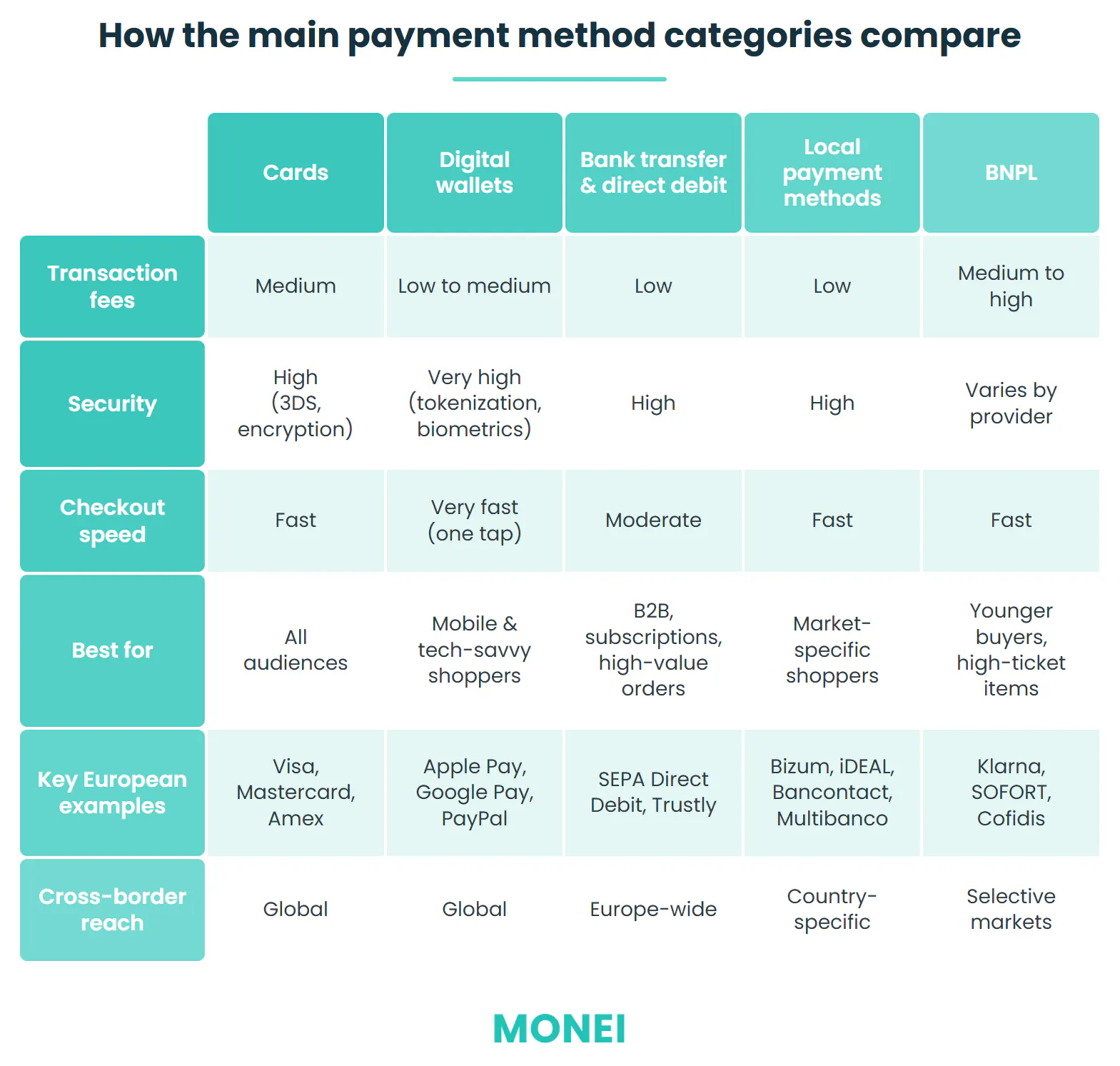
- Credit and debit cards are the global baseline. They’re accepted almost everywhere and expected by virtually every online shopper.
- Digital wallets like Apple Pay, Google Pay, and PayPal are fast-growing thanks to their security and one-tap checkout convenience.
- Bank transfers and direct debit options let customers pay directly from their bank account. These options are common in Europe, typically have lower fees, and no chargeback risk for merchants.
- Local and alternative payment methods include market-specific options like Bizum in Spain, MB Way in Portugal, and Bancontact in Belgium. It’s essential to accept them if you want to sell cross-border in Europe.
- Buy Now, Pay Later (BNPL) services like MONEI Flex, Klarna or Sequra, which let customers split purchases into installments, are effective for higher-ticket items.
- Other methods, including cash on delivery, prepaid cards, and cryptocurrency, serve niche use cases but aren't relevant for most European e-commerce stores.
📖 Read more about Types of Payment Methods
The best payment methods for e-commerce
Here are the most important payment methods to consider for your online store, organized by category.
Cards
Credit and debit cards are the foundation of any e-commerce checkout. Cards are universally expected and account for the majority of online transactions globally. Card payments in Spain are forecast to surpass $550 billion in 2029, according to GlobalData.
Accepting cards in Spain requires a TPV virtual and payment gateway, but with MONEI’s built-in merchant acquiring services, you can skip the headache of opening a separate TPV virtual account with an acquiring bank.
Digital wallets
- Apple Pay is used by over 700 million shoppers worldwide. It stores card details securely on Apple devices and authorizes payments via Face ID or Touch ID, so the actual card number is never shared with the merchant.
- Google Pay serves approximately 200 to 250 million active users globally, and works across Android devices and autofills on Chrome, speeding up checkout. It functions similarly to Apple Pay in terms of security and convenience.
- PayPal has over 430 million active users globally, maintaining its position as one of the most trusted payment options online, particularly for shoppers who are hesitant to enter card details on unfamiliar stores.
- Click to Pay is a one-click checkout option, backed by Visa, Mastercard, and Discover, that lets returning cardholders complete purchases without re-entering their details. Adoption is still growing, but it’s worth enabling in your store’s checkout.
Bank transfers and direct debit
- SEPA Direct Debit is a pan-European direct debit system covering 36 countries that lets you collect Euro-denominated payments directly from customers' bank accounts. There are no chargebacks, lower fees than cards, and it’s well-suited to subscriptions and high-value orders.
- iDEAL is the dominant payment method in the Netherlands, but it’s being phased into Wero, the new, unified European digital wallet built on iDEAL's infrastructure. It has the same speed and security features, but its reach will expand to a pan-European level (including Germany, France, and Belgium), and it includes new features such as built-in purchase protection and peer-to-peer payments.
- Bancontact is connected to 20 Belgian banks and is the payment leader in Belgium. If you’d like to reach customers in Belgium, it’s essential to offer it.
Local and mobile payment methods
- Bizum is Spain's leading mobile payment method, with over 27 million users and 70,000 merchants accepting it. Customers can pay directly from their banking app using just a phone number. No card details are required.
- Multibanco is Portugal's most-used local payment method, allowing customers to pay without sharing card or personal information and with no chargeback risk for merchants.
- MB Way is Multibanco’s mobile counterpart, with over 3.5 million active users making around 9 million purchases per month.
Buy Now, Pay Later
- Klarna is one of the largest BNPL providers globally, with over 100 million active users across more than one million merchants. It offers pay now, pay later, and installment options and is popular among shoppers under 35.
- Sequra is a Barcelona-based BNPL provider that leads adoption in Spain and is growing across Southern Europe. It offers split payments, pay-in-30, and longer-term installment plans, with particular strength in fashion, home goods, and electronics. For merchants selling to Spanish shoppers, Sequra is often the most recognized BNPL brand at checkout, alongside Klarna.
- MONEI Flex lets you offer BNPL at checkout via a built-in payment-splitting option that uses the shopper's existing credit card. They don’t need to create a separate account, and there’s no extra paperwork for you. Note: it’s currently only available for car payments.
Why offer multiple payment methods for your e-commerce store?
No two shoppers pay the same way. Someone in the Netherlands expects iDEAL at checkout; a mobile shopper in Spain will look for Bizum; a B2B buyer placing a large order may prefer a bank transfer. If your store doesn't offer what customers trust, they’ll leave, and most won't come back.
Cart abandonment due to a lack of preferred payment options is one of the top reasons shoppers don't complete a purchase. Meanwhile, 94% of cross-border shoppers expect to pay in their local currency, so stores that add a locally preferred payment method in a new market see conversion rates jump significantly.
Beyond conversion, offering multiple methods also builds trust. A checkout page with recognizable, locally relevant options signals that a store understands its customers. That matters especially for first-time buyers who haven't yet established trust with your brand.
Simply put, more payment options means fewer abandoned carts, higher average order values, and stronger performance in every market you sell into.
How to choose the right payment methods for your store
Not every payment method makes sense for every business. The right mix depends on a few key factors.
Your target markets
Payment preferences vary significantly by country. iDEAL dominates in the Netherlands, Bizum is widely used in Spain, Multibanco is the default for many Portuguese shoppers, and SEPA Direct Debit is standard for subscriptions across the eurozone. If you're selling into a specific market—or planning to expand—research local preferences first. Launching without the right local method is one of the fastest ways to lose sales in a new region.
Your product and average order value
Digital wallets like Apple Pay and Google Pay are ideal for low-friction impulse purchases, especially on mobile devices. Bank transfers and direct debit tend to suit higher-value or B2B orders, where buyers prefer to pay directly from their bank account. BNPL options like Klarna work well for mid- to high-ticket items where spreading the cost increases purchase likelihood.
Your customer profile
Younger shoppers are more likely to use digital wallets or BNPL. Business buyers often prefer invoicing or bank transfer. Mobile-first audiences expect one-tap checkout. Understanding who your customers are shapes which methods move the needle.
Fees and operational complexity
Each payment method carries different transaction costs, settlement timelines, and integration requirements. Cards and digital wallets settle quickly, while bank transfers can take longer. Managing multiple separate integrations also adds overhead, which is why many merchants opt for a single payment platform that handles all methods in one place.
Start with the methods that cover the majority of your audience, then layer in local or niche options as you expand.
Payment method trends to watch
The e-commerce payments landscape keeps shifting. Here are the trends shaping how shoppers pay online:
- BNPL growth continues. Buy now, pay later is expanding beyond fashion and electronics into travel, healthcare, and B2B purchasing. Providers like Klarna are increasingly embedded at checkout across European markets.
- Account-to-account (A2A) payments are gaining ground. Open banking is enabling faster, lower-cost direct bank payments, bypassing card networks entirely. In Europe, this is accelerating through initiatives like the EU's Instant Payments Regulation.
- One-click and biometric checkout are becoming the standard. Shoppers expect frictionless experiences. Digital wallets with biometric authentication are pushing checkout closer to zero steps.
- Local payment methods are going cross-border. Methods like iDEAL and Bizum are expanding their reach beyond their home markets, making them viable options for stores targeting European shoppers more broadly.
Start accepting the payment methods your customers use
The best e-commerce stores don't just accept payments; they make paying easy, familiar, and friction-free for every customer, in every market.
That means offering cards and digital wallets as a baseline, layering in local methods for the markets you serve, and giving buyers flexible options like BNPL for higher-value purchases. Getting this right means fewer abandoned carts, higher conversion rates, and greater confidence among first-time buyers.
MONEI lets you manage all of this from a single platform, including cards, digital wallets, SEPA Direct Debit (Beta), Bizum, Multibanco, BNPL, and more, so you don’t have to juggle multiple providers or integrations.
Create your MONEI account and start offering the payment methods that grow your business.

Sources used:
- Spain card payments to surpass $550 billion in 2029 - GlobalData
- 50 Cart Abandonment Rate Statistics 2026 - Baymard Institute
- Going Global: How Payments Optimization Can Power an International Commerce Strategy - PYMNTS
- Instant Payments Regulation - European Union
Last sources check: 29/06/2026
Payment methods for e-commerce FAQ
The essentials are credit and debit cards (Visa, Mastercard), digital wallets (Apple Pay, Google Pay, PayPal), and bank transfers or direct debit for markets where those are preferred. Beyond the basics, the right mix depends on where you sell. European stores should also consider local payment methods like iDEAL, Bizum, or Multibanco to avoid losing customers at checkout.
There's no single right number, but most e-commerce stores benefit from offering at least 3–5 payment methods that cover different shopper preferences. Start with cards and one or two digital wallets, then add local or alternative methods based on your target markets. More options generally means fewer abandoned carts, as long as the checkout experience stays clean and uncluttered.
Yes, especially if you're selling into specific European markets. iDEAL accounts for a large share of online transactions in the Netherlands, Bizum is widely used in Spain, and Multibanco is a default payment method in Portugal. Shoppers in these markets often abandon checkout if their preferred method isn't available.
The simplest approach is using a payment platform (like MONEI) that supports multiple methods through a single integration, rather than connecting to each provider separately. This reduces technical overhead, simplifies reconciliation, and makes it easier to add new methods as your business grows.

Alexis Damen
Alexis Damen is a former Shopify merchant turned content marketer. Here, she breaks down complex topics about payments, e-commerce, and retail to help you succeed (with MONEI as your payments partner, of course).